1940sIndustry action
Commercial production of PFAS begins
Learn more →
Science-backed information to help you understand PFAS, their potential health impacts, and how to reduce your exposure.
Per- and polyfluoroalkyl substances (PFAS) are a family of thousands of man-made chemicals built around one of the strongest bonds in organic chemistry: carbon–fluorine. That bond makes PFAS remarkably resistant to heat, water, oil, and degradation which is exactly why industry has used them since the 1940s in non-stick coatings, water-repellent fabrics, firefighting foams, and countless industrial processes.
The same durability that makes PFAS useful also makes them persistent. They break down extremely slowly, if at all, earning the nickname "forever chemicals." Over decades of widespread use they have accumulated in water, soil, wildlife and people. CDC biomonitoring has found PFAS in the blood of about 97% of Americans.
Not all PFAS are alike. "Long-chain" legacy compounds like PFOA and PFOS were largely phased out of U.S. manufacturing but remain in the environment and in people because they leave the body slowly, with half-lives measured in years. Newer replacement compounds are still being studied.
Eighty years separate the first non-stick pan from the first enforceable US drinking-water limit. The timeline below is the short version; color marks what kind of action each was, because they are not interchangeable: an industry phase-out is voluntary, a treaty listing binds countries, a hazard classification sets no limit, and only an EPA rule sets a number a US utility must meet.
Commercial production of PFAS begins
Learn more →3M announces and completes its PFOS phase-out
Learn more →EPA PFOA Stewardship Program; US manufacture of PFOA and long-chain homologues ends
Learn more →PFOS listed under the Stockholm Convention, Annex B (restriction)
Learn more →PFOA listed, Annex A (elimination)
Learn more →PFHxS listed, Annex A
Learn more →IARC classifies PFOA as Group 1 (carcinogenic to humans) and PFOS as Group 2B
Learn more →EPA finalizes the first US drinking-water limits for six PFAS
Learn more →Long-chain PFCAs (C9 to C21) added to Annex A, capturing six compounds in our panel
Learn more →EPA proposes rescinding four of the six limits, upholding PFOA and PFOS. Unresolved
Learn more →Proposed compliance deadline, if the extension stands
Learn more →Dozens of everyday routes lead to exposure. These four reach almost everyone.
Contaminated municipal supplies and private wells are the most common exposure route in the U.S. and private wells fall outside federal limits.
PFAS build up in fish from contaminated waters, and farmland treated with contaminated biosolids can pass them into milk, beef, and eggs.
Grease-resistant wrappers, takeout containers, and microwave popcorn bags plus older non-stick coatings built on PFAS chemistry.
Water-repellent fabrics, carpets, and household dust, alongside waterproof makeup and dental floss.
The health areas below follow The National Academies of Sciences, Engineering, and Medicine (NASEM) consensus report on PFAS exposure and testing.
PFAS research keeps growing. If any of these matter to you, knowing your exposure gives you a place to start.
Every sector on this wheel sheds compounds from our 40-PFAS panel. Click any point to explore.
All 40 PFAS we measure. The ones this sector sheds light up; the rest dim.
Forever Chemicals don’t leave quickly. Every PFAS has its own half-life: the time your body needs to clear half of it. Some take days. Others take years.
Tap any compound to see how long it takes to clear.
If you stopped taking a chemical in today, its half-life is simply how long your body needs to get rid of half of what’s already there. Wait that long again and half of what’s left goes too.
So for a PFAS with a 5-year half-life, levels come down over decades, not weeks even after the source is gone. That is why measuring early, and cutting what you can control, matters.
Only the PFAS with an established human half-life are shown. Compiled from ATSDR and peer-reviewed studies the same reference set behind your report. A half-life is the time to clear half; full clearance takes several half-lives. The 26 compounds without a firm human value are itemised in your full report.
Our at-home test measures 40 PFAS compounds to give you a clear picture of your exposure.
The National Academies of Sciences, Engineering, and Medicine (NASEM) are three private, non-profit institutions in Washington, D.C. that provide independent, evidence-based advice to the nation on science, engineering, and health.
In Guidance on PFAS Exposure, Testing, and Clinical Follow-Up (2022), an expert committee reviewed the published research and sorted health outcomes by how strong the evidence is. They also recommended that clinicians offer PFAS blood testing to patients likely to have elevated exposure, and use the result to guide follow-up care.
These are all the outcomes NASEM placed above its default tier four with sufficient evidence, six with limited or suggestive evidence. Everything else they reviewed was rated inadequate or insufficient to determine an association.
| Health area | NASEM evidence tier |
|---|---|
| Immune function (antibody response) | Sufficient |
| Cholesterol (dyslipidemia) | Sufficient |
| Pregnancy (infant & fetal growth) | Sufficient |
| Kidney cancer (adults) | Sufficient |
| Breast cancer (adults) | Limited / suggestive |
| Liver (enzyme changes) | Limited / suggestive |
| Pregnancy-induced hypertension (incl. preeclampsia) | Limited / suggestive |
| Testicular cancer (adults) | Limited / suggestive |
| Thyroid disease & dysfunction (adults) | Limited / suggestive |
| Ulcerative colitis (adults) | Limited / suggestive |
These are the health areas researchers are actively studying in relation to PFAS exposure not a list of things a test result can diagnose. An association found across a population cannot tell any individual why they have a given condition. What your result can do is show how much PFAS you carry, how that compares to the U.S. population, and whether it falls in a range where NASEM suggests clinical follow-up is worth discussing with your doctor.
Status Health is not affiliated with, and not endorsed by, the National Academies of Sciences, Engineering, and Medicine (NASEM). We cite their work as an independent evidence source.
Reduced infant and fetal growth is one of four outcomes the NASEM committee placed in its strongest evidence category. Pregnancy-induced hypertension including gestational hypertension and preeclampsia sits one tier below, in limited or suggestive evidence.
If you are planning a pregnancy, NASEM's guidance is that a serum PFAS result can inform the conversation with your clinician it does not predict any individual outcome.
Source: Guidance on PFAS Exposure, Testing, and Clinical Follow-Up, National Academies of Sciences, Engineering, and Medicine (NASEM).
Status Health is not affiliated with, and not endorsed by, the National Academies of Sciences, Engineering, and Medicine (NASEM). Summarised in our own words from their public report.
The committee placed thyroid disease and dysfunction in adults in the limited or suggestive evidence category. That means studies point toward an association, but confounding, chance, or bias could not be ruled out with confidence.
Thyroid effects remain an active research area rather than an established finding.
Source: Guidance on PFAS Exposure, Testing, and Clinical Follow-Up, National Academies of Sciences, Engineering, and Medicine (NASEM).
Status Health is not affiliated with, and not endorsed by, the National Academies of Sciences, Engineering, and Medicine (NASEM). Summarised in our own words from their public report.
Decreased antibody response in both adults and children is the immune finding NASEM placed in its strongest category. It is the most consistently reproduced human health effect of PFAS exposure.
In practice this refers to how strongly the immune system responds to vaccination, measured across populations.
Source: Guidance on PFAS Exposure, Testing, and Clinical Follow-Up, National Academies of Sciences, Engineering, and Medicine (NASEM).
Status Health is not affiliated with, and not endorsed by, the National Academies of Sciences, Engineering, and Medicine (NASEM). Summarised in our own words from their public report.
Dyslipidemia abnormal blood lipids, including elevated cholesterol in adults and children is in NASEM's sufficient evidence category. Liver enzyme alterations sit one tier lower.
Cholesterol is routinely measured in standard blood work, which makes it one of the easiest areas to follow over time.
Source: Guidance on PFAS Exposure, Testing, and Clinical Follow-Up, National Academies of Sciences, Engineering, and Medicine (NASEM).
Status Health is not affiliated with, and not endorsed by, the National Academies of Sciences, Engineering, and Medicine (NASEM). Summarised in our own words from their public report.
Increased risk of kidney cancer in adults is the fourth outcome in NASEM's sufficient evidence category. Testicular and breast cancer were placed one tier lower.
An association measured across a population cannot tell any individual why they developed a condition.
Source: Guidance on PFAS Exposure, Testing, and Clinical Follow-Up, National Academies of Sciences, Engineering, and Medicine (NASEM).
Status Health is not affiliated with, and not endorsed by, the National Academies of Sciences, Engineering, and Medicine (NASEM). Summarised in our own words from their public report.
This one isn't a NASEM health outcome it's the practical reason most people test. PFAS exposure produces no symptoms you can feel, so the only way to know your level is to measure it.
A baseline turns an open-ended worry into a number you can track.
Source: Guidance on PFAS Exposure, Testing, and Clinical Follow-Up, National Academies of Sciences, Engineering, and Medicine (NASEM).
Status Health is not affiliated with, and not endorsed by, the National Academies of Sciences, Engineering, and Medicine (NASEM). Summarised in our own words from their public report.
For most people this is the single largest contributor. PFAS reach tap water from industrial discharge, landfill leachate, treated sewage sludge spread on farmland, and firefighting foam used at airports and military sites. Because the carbon–fluorine bond resists normal treatment, conventional municipal filtration does not remove them.
| PFOA | EPA limit 4 ppt health goal zero |
| PFOS | EPA limit 4 ppt health goal zero |
| PFHxS | EPA limit 10 ppt |
| PFNA | EPA limit 10 ppt |
| HFPO-DA (GenX) | EPA limit 10 ppt |
| PFBS | counted in EPA's Hazard Index |
| PFBA, PFPeA, PFHxA | short-chain replacements, highly water-mobile |
In 2024 the EPA set the first national drinking-water limits for PFAS. They cover six compounds all six are in our 40-compound panel. Private wells are not covered by those limits at all.
Certified activated-carbon or reverse-osmosis filtration substantially reduces PFAS in drinking and cooking water.
PFAS dissolve readily in water and resist the coagulation, sedimentation and chlorination steps that municipal plants rely on. Short-chain replacements are the most mobile of all, traveling furthest from a contamination source. Levels vary enormously between neighboring systems, which is why a blood test tells you more about your own exposure than a map does.
 U.S. EPA
The federal agency created in 1970 that sets and enforces national environmental standards. In April 2024 it issued the first legally enforceable national drinking-water limits for PFAS.
epa.gov → CDC · NHANES
The CDC program that has measured PFAS in Americans’ blood since 1999. It is the source of the population percentiles your results are compared against.
cdc.gov →Explore all 40 compounds in the Chemical Glossary →
Compound lists reflect where each substance is most commonly reported. Every compound named here is included in the Status Health panel.
PFAS climb the food chain. Long-chain compounds bind to proteins in tissue rather than fat, so they concentrate in fish from contaminated rivers and lakes, and in livestock raised on land treated with contaminated biosolids or drinking contaminated water.
| PFOS | the dominant compound found in freshwater fish |
| PFDA | long-chain, accumulates in tissue |
| PFUnDA | long-chain, found in fish and game |
| PFDoA | long-chain, bioaccumulative |
| PFTrDA, PFTeDA | very long-chain, retained longest |
| PFNA | found in both water and food-chain routes |
The EPA's own biosolids modelling traces PFAS from treated farmland into milk, beef, eggs, poultry and fish the same pathways our panel measures.
Local fish-consumption advisories are the best guide where they exist; varying protein sources lowers reliance on any single route.
Unlike many pollutants, PFAS bind to proteins rather than fat, so they accumulate in muscle and organ tissue the parts we eat. Each step up the food chain multiplies the concentration, which is why freshwater fish can carry levels far above the water they swim in, and why livestock raised on treated land can pass PFAS into milk and eggs.
U.S. EPAThe federal agency created in 1970 that sets and enforces national environmental standards. In April 2024 it issued the first legally enforceable national drinking-water limits for PFAS.
epa.gov → U.S. FDA
Regulates substances that come into contact with food. In 2024 it confirmed that PFAS grease-proofing agents are no longer sold for food-contact use in the United States.
fda.gov →Explore all 40 compounds in the Chemical Glossary →
Compound lists reflect where each substance is most commonly reported. Every compound named here is included in the Status Health panel.
Grease-resistant coatings on food wrappers and containers are built from fluorotelomer chemistry, which breaks down into measurable PFAS. Older non-stick cookware used PFOA in manufacturing, and worn or overheated coatings can release residues.
| 6:2 FTS, 8:2 FTS | fluorotelomer sulfonates from coatings |
| 3:3, 5:3, 7:3 FTCA | fluorotelomer breakdown products |
| PFOA | legacy non-stick manufacturing |
| PFHxA | common short-chain replacement in paper coatings |
| PFBA | short-chain, widely detected in packaging |
Fluorotelomer compounds are precursors: they degrade in the environment and in the body into the terminal acids like PFOA that a blood test detects.
Glass or stainless steel for storage, and replacing scratched non-stick pans, removes the most direct contact routes.
Coatings rarely contain the compounds a blood test measures. They contain fluorotelomers, which degrade in the environment and in the body into stable terminal acids such as PFOA. That conversion is why a panel covering 40 compounds, including precursors and their breakdown products, captures exposure a five-compound test would miss entirely.
U.S. FDARegulates substances that come into contact with food. In 2024 it confirmed that PFAS grease-proofing agents are no longer sold for food-contact use in the United States.
fda.gov →U.S. EPAThe federal agency created in 1970 that sets and enforces national environmental standards. In April 2024 it issued the first legally enforceable national drinking-water limits for PFAS.
epa.gov →Explore all 40 compounds in the Chemical Glossary →
Compound lists reflect where each substance is most commonly reported. Every compound named here is included in the Status Health panel.
Stain- and water-repellent treatments on carpet, upholstery and outdoor clothing shed into household dust a major indoor route, especially for young children. Some cosmetics, dental floss and personal-care products also contain fluorinated ingredients.
| N-MeFOSAA | sulfonamide precursor, tracked in national biomonitoring |
| N-EtFOSAA | sulfonamide precursor from treated textiles |
| PFOSA (FOSA) | precursor that converts to PFOS in the body |
| N-MeFOSE, N-EtFOSE | used in coatings and treatments |
| PFHxS | associated with carpet and textile treatments |
| PFOS | legacy stain-repellent chemistry |
Precursor compounds matter because they convert into the long-lived acids after exposure which is why a 40-compound panel sees more than a 5-compound one.
HEPA vacuuming, damp dusting, and skipping optional stain-resistance treatments reduce the indoor dust route.
Treated fabrics shed micro-fragments continuously, and PFAS bind to household dust that settles on floors and surfaces. Young children ingest markedly more dust than adults through hand-to-mouth contact, which makes the home environment one of the more significant routes for them. Sulfonamide precursors from these treatments convert into PFOS after exposure.
CDC · NHANESThe CDC program that has measured PFAS in Americans’ blood since 1999. It is the source of the population percentiles your results are compared against.
cdc.gov → ATSDR
ATSDRThe CDC agency that publishes the Toxicological Profile for Perfluoroalkyls, the standard reference on how these compounds behave in the body.
atsdr.cdc.gov →Explore all 40 compounds in the Chemical Glossary →
Compound lists reflect where each substance is most commonly reported. Every compound named here is included in the Status Health panel.

In 1938 a DuPont chemist, Roy Plunkett, accidentally made polytetrafluoroethylene (PTFE) later sold as Teflon. By the late 1940s DuPont was making PTFE commercially, and 3M began producing PFOA and PFOS by electrochemical fluorination. PFOA was used to manufacture non-stick coatings; PFOS went into Scotchgard, firefighting foam and paper coatings.
Sources: EPA PFAS history; 3M and DuPont litigation records; ATSDR toxicological profile.
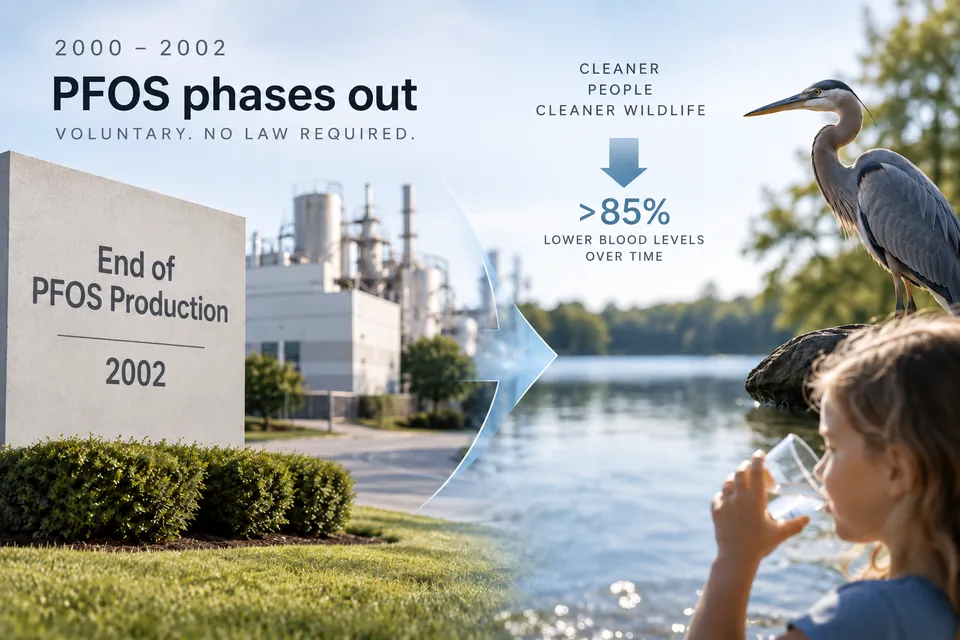
In May 2000, after the EPA had been shown data on PFOS in human blood and wildlife worldwide, 3M announced it would stop making PFOS and related chemistry. Production ended in 2002. It was a voluntary decision, not a regulation no law required it.
Sources: 3M/EPA announcement (2000); CDC NHANES trend data; Stockholm Convention Secretariat; 3M PFAS-exit announcement (Dec 2022).
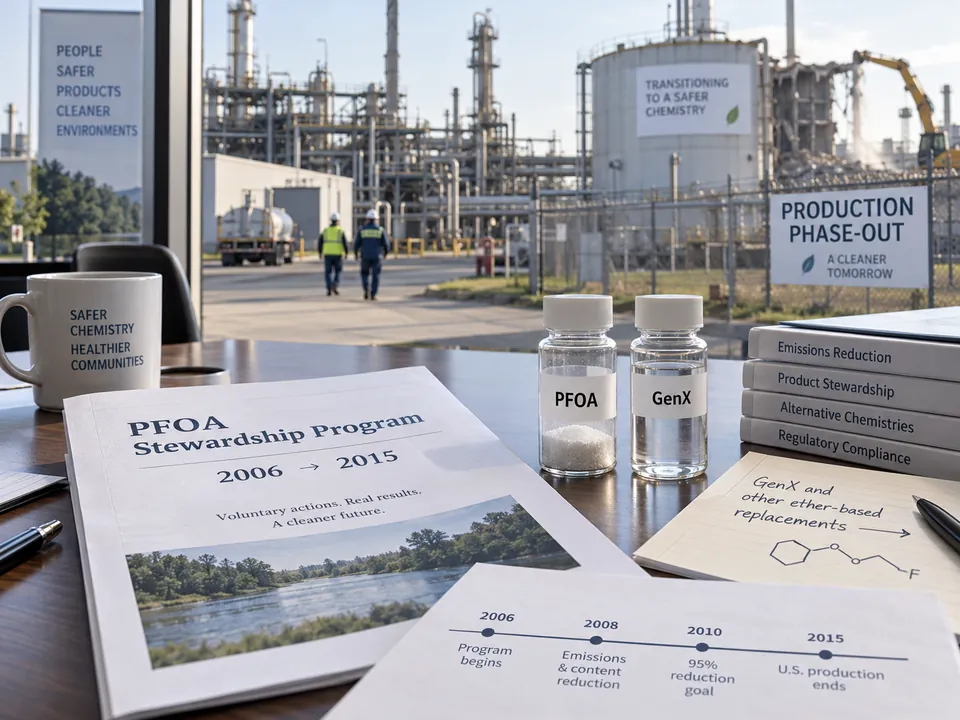
In 2006 the EPA invited the eight largest producers including DuPont, 3M, Arkema, Solvay and Daikin to cut PFOA emissions and product content by 95% by 2010 and to eliminate them by 2015. All eight met the goal. Again, it was a voluntary agreement.
Sources: EPA 2010/2015 PFOA Stewardship Program.

The Stockholm Convention is the global treaty on persistent organic pollutants. In 2009 PFOS, its salts and PFOSF became the first PFAS listed under Annex B, which restricts rather than bans, with exemptions for uses such as firefighting foam and metal plating.
Sources: Stockholm Convention Secretariat, decision SC-4/17.
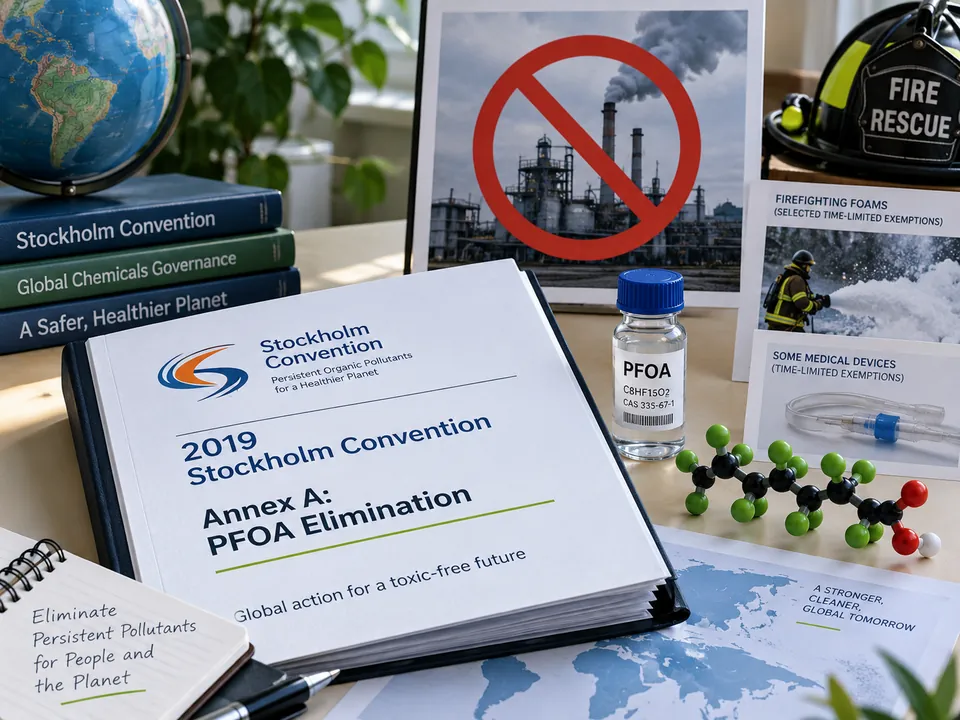
Ten years after PFOS, the Convention added PFOA, its salts and PFOA-related compounds to Annex A the elimination list with a handful of time-limited exemptions (for example some medical devices and firefighting foams).
Sources: Stockholm Convention decision SC-9/12.
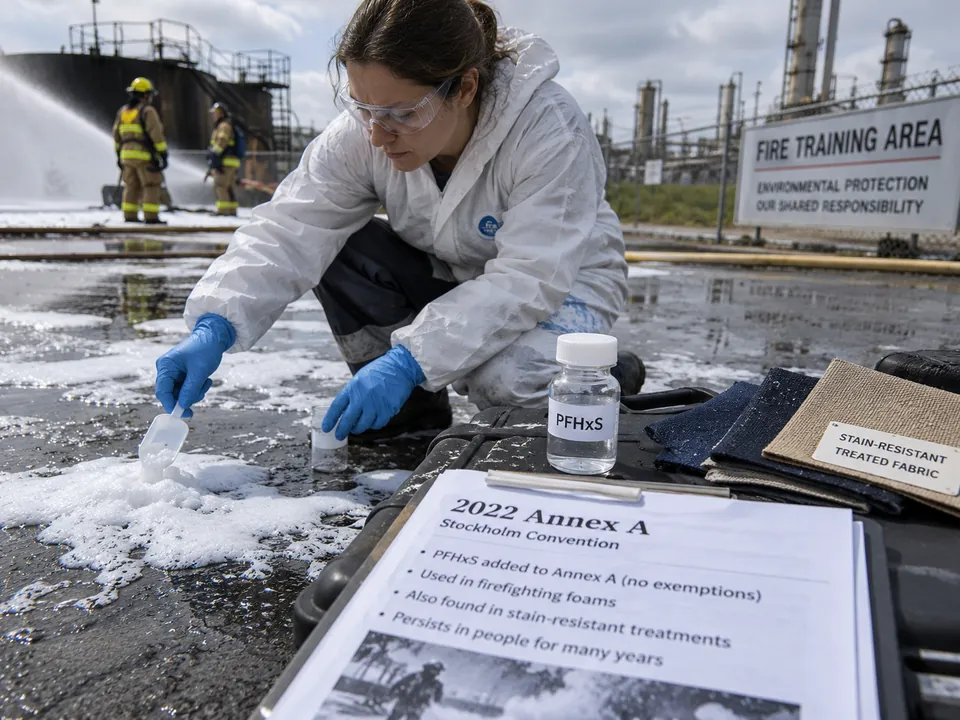
PFHxS, its salts and PFHxS-related compounds were added to Annex A in 2022 without any exemptions the cleanest listing of any PFAS so far.
Sources: Stockholm Convention decision SC-10/13.

In November 2023 the International Agency for Research on Cancer reviewed the evidence and placed PFOA in Group 1 carcinogenic to humans on sufficient evidence in animals and strong mechanistic evidence, with limited human evidence for kidney and testicular cancer. PFOS was placed in Group 2B, possibly carcinogenic.
Sources: IARC Monographs Volume 135 (2023).
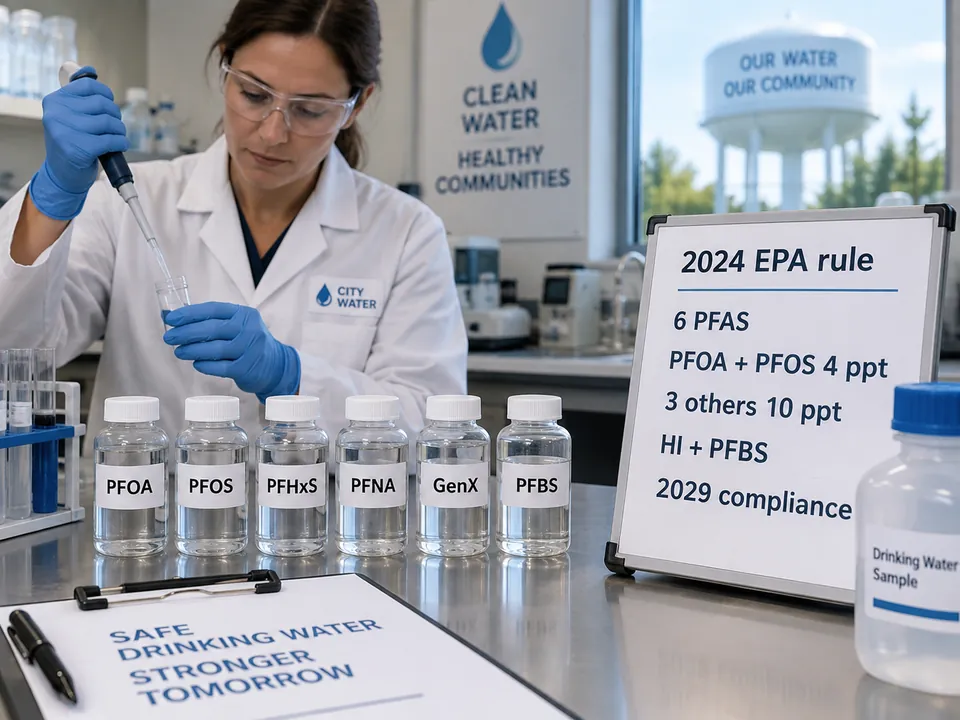
On 10 April 2024 the EPA issued the first enforceable national drinking-water standards for PFAS: maximum contaminant levels of 4 parts per trillion for PFOA and PFOS, 10 ppt for PFHxS, PFNA and GenX (HFPO-DA), and a hazard-index limit for mixtures that include PFBS. Utilities were given until 2027 to finish monitoring and until 2029 to comply.
Sources: EPA National Primary Drinking Water Regulation for PFAS, April 2024.
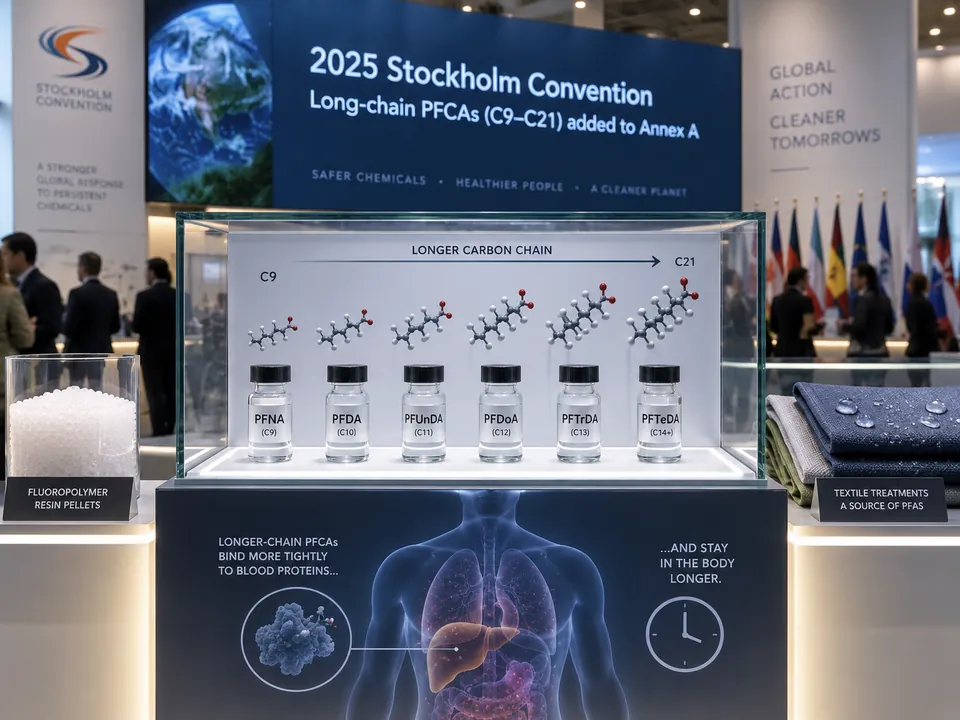
In 2025 the Convention listed long-chain perfluorocarboxylic acids with 9 to 21 carbons, their salts and related compounds under Annex A. That single decision covers PFNA, PFDA, PFUnDA, PFDoA, PFTrDA and PFTeDA.
Sources: Stockholm Convention COP-12 decisions (2025).
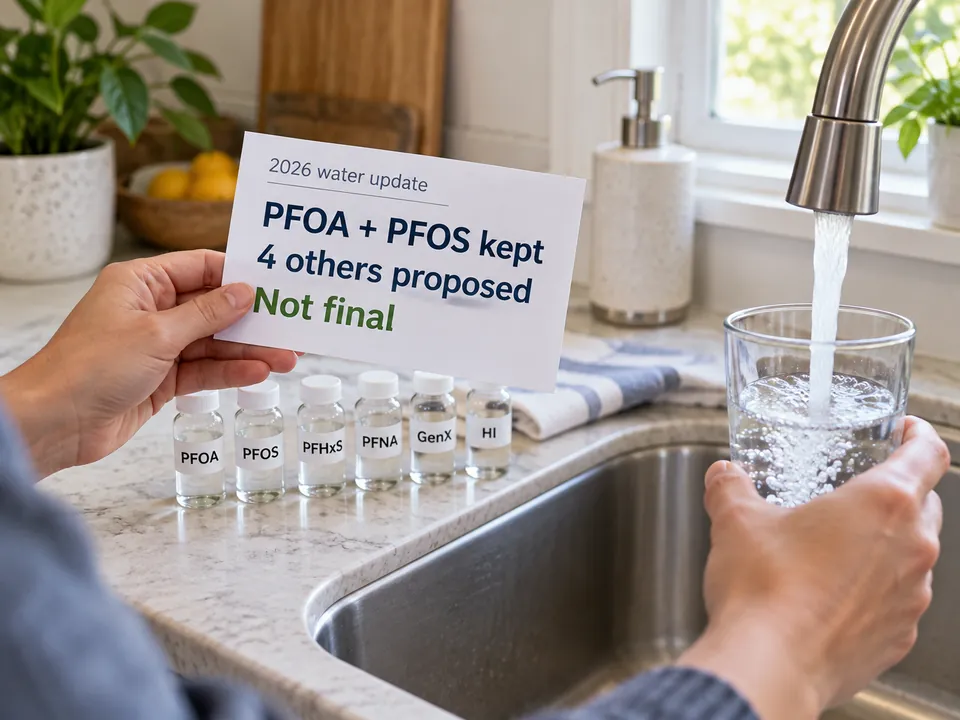
In May 2026 the EPA proposed to keep the 4 ppt limits for PFOA and PFOS but to withdraw the limits for PFHxS, PFNA, GenX and the mixture hazard index, and to extend the PFOA/PFOS compliance deadline from 2029 to 2031. The proposal is subject to public comment and litigation, and is not final.
Sources: EPA announcements, May 2026 (proposed rule; unresolved).
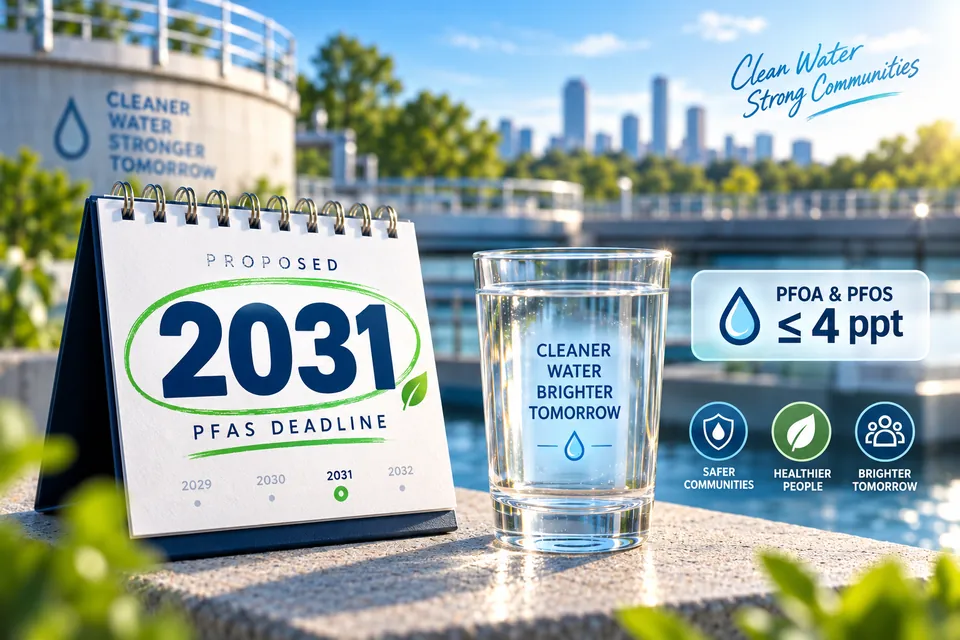
If the 2026 proposal is finalised, water utilities would have until 2031 to bring PFOA and PFOS below 4 ppt more than ninety years after commercial production began.
Status: proposed, not final. We will update this page as the rule changes.